★★★★★
"The explanations after each section were genuinely useful. I appreciated that the platform didn't try to assign me a label — it just helped me understand where I struggled and why."
Zarmiquo provides structured cognitive assessments built for clarity, not competition. Explore how you process patterns, solve problems, and reason analytically — with results presented in context, not comparison.
Interactive Demo
IQ scores are not raw counts of correct answers. They're derived from statistical distributions — normalized against a reference population. Use the slider to explore how scores map onto the population curve and what each range is understood to reflect.
This tool is purely illustrative. It does not generate or predict personal scores.
A note on interpretation
Score ranges carry descriptive labels, not value judgments. Cognitive performance is multidimensional and context-dependent.
100 — Average Range
Average Range
The average range encompasses the majority of the population. Scores here reflect typical cognitive functioning across most measured skill areas.
What We Measure
Our assessments cover six distinct domains of cognitive reasoning. Each area is evaluated independently, and results are reported with explanatory context — not a single reductive number.
Logical reasoning tasks assess your ability to identify valid arguments, evaluate premises, and draw conclusions from structured information. These questions test deductive and inductive inference — skills widely used in analytical and problem-solving contexts.
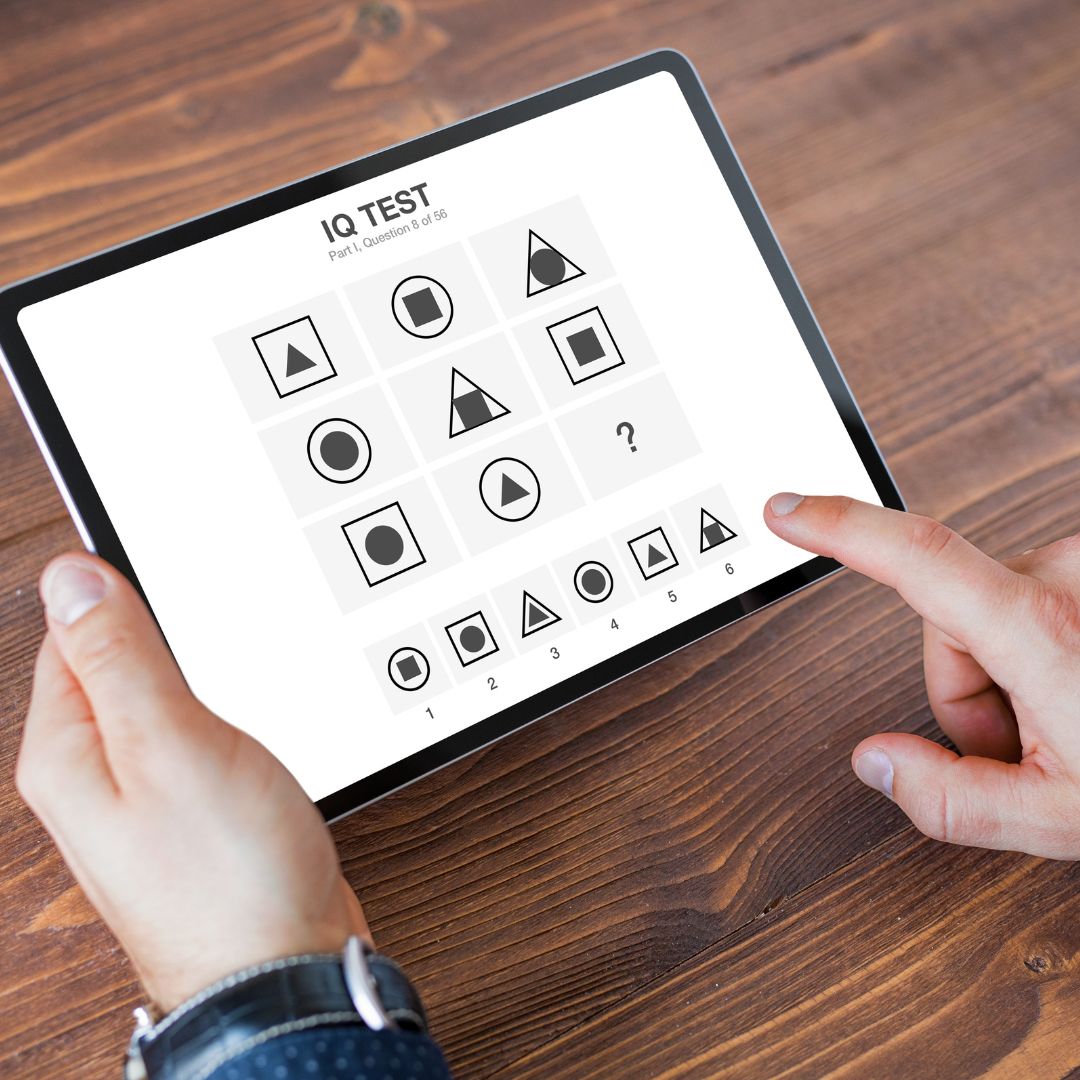
Pattern recognition questions involve identifying relationships in sequences, matrices, and visual arrangements. This domain is among the most studied in cognitive psychology, as it reflects fluid intelligence — the capacity to reason about novel information.
Verbal analysis tasks examine your ability to process language-based reasoning — analogies, word relationships, reading comprehension under constrained conditions, and the identification of semantic connections. Vocabulary breadth and language processing speed both factor in.
Spatial reasoning questions involve mentally manipulating shapes, visualizing rotations, and understanding how objects relate in three-dimensional space. This domain is often correlated with performance in technical and design-oriented fields.
Working memory tasks evaluate how efficiently you hold and manipulate information over short time spans. Strong working memory is associated with effective multitasking, learning, and complex problem-solving.
Processing speed tasks assess how quickly and accurately you can perform simple cognitive operations under timed conditions. This dimension is distinct from raw reasoning ability and reflects the efficiency of neural information processing.
Try It Out
These preview questions illustrate the format and style of Zarmiquo assessments. They are not scored and do not constitute a cognitive evaluation.
Loading questions...
What People Say
We collect feedback to improve our platform experience. Here's what participants have shared about using Zarmiquo for personal and educational exploration.
"The explanations after each section were genuinely useful. I appreciated that the platform didn't try to assign me a label — it just helped me understand where I struggled and why."
"I've tried a few IQ tools online. Most feel either gamified or anxiety-inducing. Zarmiquo's tone is refreshingly calm. The results came with context, not a dramatic score reveal."
"The spatial reasoning questions were harder than I expected — in a good way. I liked that the platform explained the methodology behind how results are framed."
"As a teacher, I used the sample questions to introduce cognitive skills to my students. The educational framing is exactly what I needed — no overpromising, just structure."
"I've been curious about cognitive assessments for years but wary of platforms that oversell results. Zarmiquo was transparent about what the numbers do and don't mean."
"The working memory section highlighted something I hadn't really thought about before. The breakdown by category was more useful than a single score would have been."
Our Commitment
Cognitive assessments are tools for understanding, not instruments of judgment. Zarmiquo is built on a simple principle: transparency comes before everything else.
Our assessments are designed for personal and educational insight. They are not psychological evaluations and should not be used as the basis for clinical decisions.
Scores are presented alongside explanatory context. We deliberately avoid language that frames results as definitive measures of your worth or potential.
Nothing on this platform constitutes a medical or psychological diagnosis. If you have clinical concerns about cognitive function, please consult a licensed professional.
IQ scores have well-documented limitations. Our platform explains these openly. A single assessment captures a narrow slice of cognitive experience.
Further Reading
Understanding cognitive assessments means understanding their context and limitations. Our editorial articles explore the science and nuance behind the tests.
Behind the familiar concept of an "IQ score" lies a structured methodology rooted in statistics, developmental psychology, and decades of iterative research.

Intelligence isn't one thing. From Spearman's g-factor to Gardner's multiple intelligences, the science of cognitive ability is richer and more contested than most people realize.

IQ tests have faced significant scrutiny from researchers over the decades. This article examines what the research actually says about the boundaries of what these tests can and cannot tell us.
Get Started
Take the first step toward understanding how you reason, recognize patterns, and process information. Results are presented for reflection — not judgment.
Begin Your Assessment